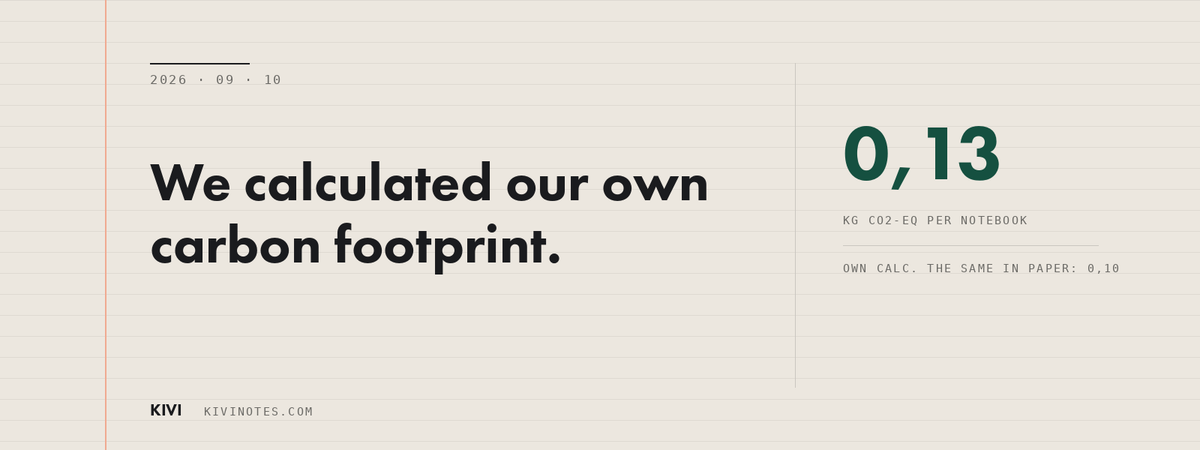
We calculated our own notebook's carbon footprint. Stone paper doesn't win.
Our B6 stone paper notebook comes out at roughly 0.13 to 0.17 kg CO2-eq. The same notebook in ordinary wood paper comes out at about 0.10. So in this calculation stone paper doesn't emit less than paper, it emits slightly more. And the difference isn't where you'd look for it: not in the factory, but at the incinerator, in a single accounting rule.
This isn't the article we set out to write. It is the one that holds up, and the whole calculation is below, including the places where it wobbles.
Why we ran the numbers ourselves
Search for stone paper and sustainability and you meet the same figures everywhere. 25 to 62 percent less CO2 than wood paper. Sometimes 94 percent. We used those figures ourselves for a while, until we tried to find the source.
The 25 to 62 percent range dead-ends. It sits on content pages citing each other rather than any study. We could not find a single scientific publication behind it. Since last month it appears nowhere on this site.
The 94 percent does exist, and we know it well, because it's ours. It comes from the life cycle assessment of MOYU, our sister company, carried out to ISO standards. But that assessment compares one erasable notebook against the fifteen disposable notebooks it replaces over three years. Almost all of the saving lives in that reuse, not in the material. A KIVI gets filled once. That mechanism doesn't exist here, so the figure doesn't apply to us.
Which left us with nothing. So we started calculating.
How we calculated it
We used MOYU's own model, built out of the LCA that Tessa Mouw produced for MOYU in 2022 to ISO 14040 and 14044. That model breaks the published 0.37 kg CO2-eq for one A5 notebook into physical items: stone paper, cover, wire binding, transport and incineration. From those you can build up any other product.
We dropped our own notebook into it: B6, 125 by 176 millimetres, 80 lined pages, softcover, thread sewn, 120 micron stone paper. And alongside it the same notebook in ordinary wood paper, at equal thickness, so you're comparing like with like.
Two things we deliberately did differently from the source report. We calculate on the notebook's physical mass, not the mass the report modelled, because that report counted the pages twice. And we show what happens when you correct the emission factor for HDPE, because the one in the report is demonstrably four times too low.
What comes out
| B6, 80 pages, 120 micron | sheets | production | transport | end of life | total |
|---|---|---|---|---|---|
| Stone paper, report's factor | 127 g | 0.059 | 0.021 | 0.050 | 0.130 |
| Stone paper, corrected HDPE factor | 127 g | 0.094 | 0.021 | 0.050 | 0.165 |
| Wood paper 96 g/m² | 85 g | 0.085 | 0.014 | 0.000 | 0.099 |
| Wood paper, incineration counted | 85 g | 0.085 | 0.014 | 0.035 | 0.134 |
All in kilograms of CO2 equivalent per notebook.
Look at the production column first. Stone paper wins there: 0.059 against 0.085. In the factory it genuinely is the cleaner material, by roughly thirty percent, exactly as the story promises.
Then look at end of life. Stone paper 0.050, paper 0.000. That's where the whole advantage goes, and then some.
Why is there a zero next to paper?
This is the heart of the article, and it's an accounting rule, not physics.
Burn paper and CO2 comes out. But that carbon was in a tree not long ago, which had taken it out of the air, so in standard methods it counts as biogenic and is scored as zero. It's a loop, not an addition.
The HDPE in stone paper comes from crude oil. That carbon sat underground for millions of years. That's fossil carbon, and it counts.
Physically both go up the same chimney. The difference is in the bookkeeping, and that bookkeeping is defensible, but it is the reason paper sits at zero here. Score paper exactly the way stone paper is scored and the paper notebook lands at 0.134, which is a draw.
Why does stone paper win per kilo and lose per notebook?
Because you need more of it.
| Material | kg CO2-eq per kg of material |
|---|---|
| Stone paper, report's factor | 0.43 |
| Stone paper, corrected factor | 0.71 |
| Wood paper, recycled | 0.73 |
| Wood paper, virgin | 0.91 to 0.95 |
Per kilogram stone paper is the cleaner material, in both variants. But stone paper is denser than paper: 1.2 grams per cubic centimetre against roughly 0.8. At the same thickness a sheet of stone paper weighs half as much again, and our notebook holds 127 grams of sheets where a paper one holds 85.
A cleaner material, of which you need fifty percent more, with an end of life that counts. That's how it lands.
So is stone paper sustainable?
On carbon it's roughly a draw, and which way it tips depends on two choices that are both defensible: which emission factor you use for HDPE, and whether you count biogenic carbon. Anyone who hands you a percentage has made those two choices for you without saying so.
That isn't the whole story, because carbon isn't the only axis you judge a material on. What is solid about stone paper:
No trees. The raw material is quarried limestone, ground to a powder. Nothing is felled for it.
No process water in forming the sheet. Making paper means stirring fibre into a water slurry and then drying that water back out. That drying is the largest heat demand in a paper mill. With stone paper the step doesn't exist, because no water is involved.
No bleach and no acid. Ground limestone is already white.
And what sits on the other side, equally plainly: it contains roughly twenty percent plastic, so it isn't biodegradable, isn't compostable and isn't plastic free. It's technically well suited to recycling with other HDPE, but there's barely a collection stream for it. We wrote about that separately.
Where this calculation wobbles
If we expect others to back up their figures, we should write down our own weak spots too.
The source is a student placement report without external review. Good work, ISO methodology, but no critical review to ISO 14071. That's the difference between an indication and a figure that survives a tender.
The HDPE emission factor in that report is four times too low. The report uses 0.43 kg CO2 per kilo of HDPE. PlasticsEurope gives 1.80, the American recycling industry independently 1.89. Which is why both variants are in the table.
The underlying data is six to seven years old. Calculated on ecoinvent 3.5 and 3.6, from 2018 and 2019; the current version is 3.12.
The emission factor for wood paper is an average. We use 0.95 kg CO2 per kilo, the average from a meta-analysis of the pulp and paper industry. For a specific mill that can differ considerably.
And the bulk of the paper we compare against is an assumption. We use 0.8 grams per cubic centimetre. Between 0.70 and 0.85 the paper notebook lands between 0.088 and 0.105, and the conclusion doesn't change.
What we make of it ourselves
We sell this notebook because it handles rain. That's why it exists: the note you make outdoors usually can't be made again, and ordinary paper cockles, tears and bleeds the moment it gets wet.
We don't sell it because it has the lowest carbon footprint, because it doesn't. We'd have preferred otherwise, and we did briefly consider simply not writing this chapter. But a brand that tells you on its product page that it's water resistant rather than waterproof can hardly pick the flattering version on the next subject.
If you want the lowest-carbon paper on your desk, buy recycled paper. If you want a page water doesn't soak into, this is a good choice, with the drawbacks that come with it.
Common questions
How much CO2 is in one KIVI notebook? Roughly 0.13 to 0.17 kg CO2 equivalent, depending on which HDPE emission factor you use. We quote that range rather than a single figure because the underlying LCA has not had a critical review.
Is stone paper better for the climate than paper? Not demonstrably. It's lower in production, higher at end of life, and the total lands about level. The result depends on how you count biogenic carbon.
Why do I see 94 percent quoted elsewhere? That figure comes from MOYU's LCA and compares one erasable notebook with fifteen disposable ones over three years. The saving lives in the reuse. For a notebook you fill once, it doesn't apply.
And the 25 to 62 percent? That range circulates widely but cannot be traced to a study. We no longer use it.
Is stone paper better at anything, then? Yes: no tree is felled for it, no process water goes into forming the sheet, and no bleach or acid is needed. Three solid facts that need no percentage.
Can I check the calculation myself? Yes. Request the spreadsheet through the contact form and we'll send it, assumptions included.
The short version
We ran our own notebook through the model built on our own LCA. Stone paper lands at 0.13 to 0.17 kg CO2-eq, ordinary paper at about 0.10. Stone paper wins in production and loses it again at the incinerator, because the plastic holding the sheet together is fossil. On carbon it's a draw. Stone paper's real advantages are no trees, no process water and no bleach. We buy it for the rain, not for the carbon.
Sources
- Mouw, T. (2022), Eindrapport stage MOYU, HAS 's-Hertogenbosch. Life cycle assessment to ISO 14040 and 14044, run in EcoChain Mobius on ecoinvent 3.5 and 3.6. The source of every emission item in this article.
- PlasticsEurope, Eco-profiles: HDPE 1.80 kg CO2-eq per kilo.
- Association of Plastic Recyclers (2020), Recycled vs. Virgin LCA: virgin HDPE 1.89 kg CO2-eq per kilo.
- Meta-analysis of energy use and emissions in the pulp and paper industry: an average of 951 kg CO2-eq per tonne of paper, cradle to gate.
- DEFRA conversion factors: 910 kg CO2 per tonne of virgin paper, 730 per tonne recycled.
- University of Michigan SEAS (2016), Stone Paper LCA, to ISO 14040 and 14044. Compares stone paper with coated paper and polypropylene film as bottle labels; gives a mixed picture per impact category and no headline percentage.
- Stone paper density 1.2 g/cm³: measured reference of 240 g/m² at 200 micron, Applied Sciences 14(15), 2024.
- ecoinvent version history: 3.5 (2018) and 3.6 (2019) used in the source report; current version is 3.12 (2025).
KIVI B6, ruled, 80 pages, € 14.95. The waitlist gets 10% off.