Tree-free paper outdoors: which of the four survives rain?
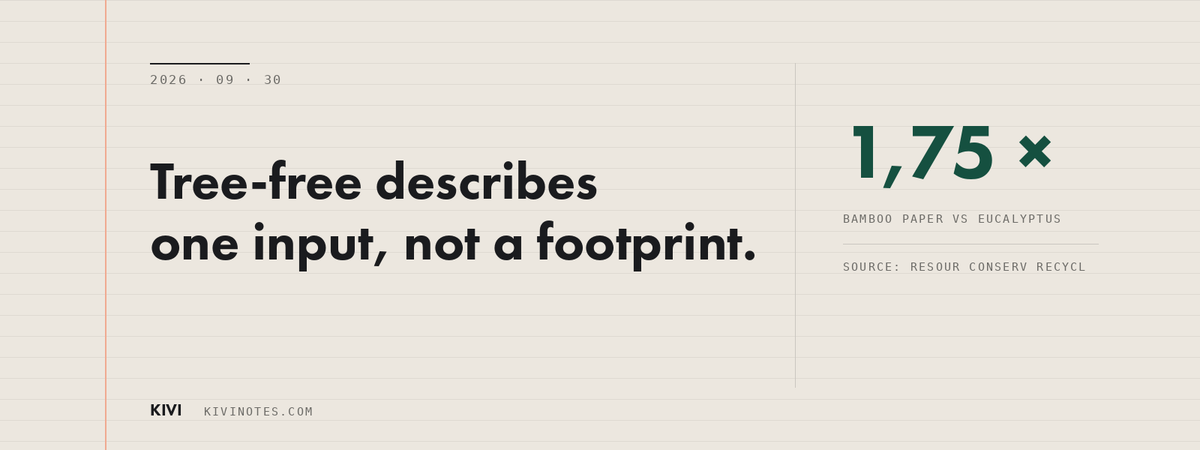
Of the four tree-free papers you will actually meet in a shop, sugarcane bagasse, bamboo, hemp and stone paper, one takes up no water, and that is the only reason it is on this site. Tree-free sounds like a verdict, and it is not. It describes one input, not a footprint: a 2024 comparative study found bamboo office paper had a global warming potential roughly 1.75 to 1.94 times higher than the eucalyptus paper it is sold as an alternative to. So no tree was cut, and the carbon went up.
That figure appears in none of the eco-listicles I found. So here are the four materials, what each does well, where the story stops being flattering, and which one is any use outdoors.
What "tree-free" actually claims
Tree-free means the fibre or filler did not come from a forest. It says nothing about the energy used to pulp it, the chemicals used to bleach it, the water it drank, the distance it travelled, or what happens to the sheet after you are done with it. A paper can be tree-free and still be pulped in a coal-powered mill on the other side of the world.
That matters. Pulping is where most of the impact sits rather than growing, because turning a stalk or a log into loose fibre, bleaching it white and then drying it back out is the energy-hungry half of the job. Three of the four materials below go through exactly that industrial process. Only one skips it.
Sugarcane bagasse
Bagasse is what is left of the cane after the sugar has been pressed out. It is a genuine waste stream, produced in enormous volume next to mills that already exist, and historically much of it was simply burned. Its composition works for papermaking: roughly 45 percent cellulose, with about 20 percent lignin, which is lower than most woods and means less chemical work to break down.
The savings that circulate for bagasse are figures we cannot trace. You will meet estimates of 60 to 80 percent less greenhouse gas than conventional wood-pulp paper, with claims of roughly half the water and a third less energy. We could not find a study behind any of them, only pages citing each other. That does not make them untrue, but it does make them uncheckable, so we mention them here without adopting them. What is solid is the mechanism: bagasse arrives at the mill already crushed and partly broken down, and that genuinely saves on both counts.
The catch is agricultural, not industrial. Sugarcane itself is a thirsty monoculture crop with a real land and water footprint, and bagasse only looks free because that footprint has already been assigned to the sugar. It is a good use of a residue, not a paper grown from nothing.
Bamboo
Bamboo is the one that surprises people. It grows fast, some species reach harvest in three years, and it regrows from the same root system without replanting. On paper, before any paper is made, it looks unbeatable.
Then the LCAs land. A 2024 comparative study of bamboo-based office paper put its global warming potential at roughly 1.75 to 1.94 times that of eucalyptus-based office paper. Research at NC State on bath tissue pointed the same direction, finding bamboo tissue carried a higher carbon footprint than eucalyptus and softwood blends. The reason is not the plant. It is that bamboo is dense and silica-rich, which makes it harder to pulp, so it takes more chemical and thermal energy to turn into a usable sheet, and much of that energy is currently supplied in regions with carbon-heavy grids.
Bamboo still does one thing well: it takes pressure off forests, which is a land-use argument rather than a carbon one. If that is your priority, it holds up. If your priority is emissions, the evidence right now does not support the marketing.
Hemp
Hemp is the material with the best story and the smallest industry. The number you will see everywhere traces back to USDA Bulletin 404 from 1916, which reported that an acre of hemp in annual rotation could yield as much pulp over twenty years as roughly 4.1 acres of forest. The lignin case is also favourable, since hemp sits far below wood, which means less bleaching.
The problem is that almost none of this reaches a shelf. Hemp pulp costs in the region of 2,500 dollars a ton against roughly 400 for bleached wood pulp, and world production of non-wood hemp pulp sits near 120,000 tons a year spread across a handful of mills, mostly in China and India. A single conventional paper mill produces many times that on its own. What is sold as hemp paper is therefore usually a blend, often a minority of hemp with recycled or wood fibre making up the rest, because the machines and the supply chain were built for wood.
None of that makes hemp a bad material. It makes it a material with a century-old citation and no infrastructure behind it, and you should read the fibre percentage on any hemp notebook before you pay a premium for the word.
Stone paper
Stone paper is the odd one out, because it is not pulped at all. It is roughly 80 percent ground calcium carbonate, quarried limestone milled to a powder, bound with about 20 percent HDPE and rolled into a sheet. There is no fibre, no process water, no bleach, because the limestone is already white. That skipped step is where its manufacturing case comes from, and the case is real: in our own calculation, making the sheet lands around a third below wood-pulp paper. Over the full life cycle that advantage goes back at the incinerator and then some, because the binder is fossil: the same notebook in ordinary paper comes out at less than half. The whole calculation, with sources, is in we calculated our own notebook's carbon footprint.
It also behaves differently in a way the other three do not. Because there is no fibre to absorb anything, the sheet does not cockle, pulp or go transparent when it gets wet. That is not a sustainability feature, it is a durability one, and it is the reason we use it.
Then the honest half. The binder is fossil plastic, so stone paper is not biodegradable, not compostable and not plastic free. It is technically recyclable with other HDPE and almost never accepted by household schemes in practice, which we cover in our piece on recycling stone paper. Against recycled paper its advantage narrows considerably, and against virgin wood pulp it holds.
The four side by side
| Bagasse | Bamboo | Hemp | Stone paper | |
|---|---|---|---|---|
| Raw material | Sugar-mill residue | Fast-growing grass | Annual fibre crop | Ground limestone plus HDPE |
| Needs pulping | Yes, but partly pre-processed | Yes, and it is hard to pulp | Yes | No |
| Carbon vs wood pulp | Savings reported, source untraceable | Higher, about 1.75 to 1.94x eucalyptus in a 2024 study | Favourable in theory, little data at scale | Lower when making the sheet, higher over the full life cycle |
| Water resistance | No | No | No | Yes, the sheet does not absorb |
| Contains plastic | No | No | No | Yes, around 20 percent HDPE |
| Recyclable in practice | With paper | With paper | With paper | Rarely collected |
| Available at scale | Yes | Yes | No | Yes |
What tree-free does not tell you
Three things get quietly assumed whenever the label appears.
That it is compostable. It usually is not, and stone paper certainly is not, because the plastic binder stays plastic.
That it is recyclable. Bagasse, bamboo and hemp go into the paper stream without much fuss. Stone paper does not, and that is the single biggest weakness in its case.
That it is certified. Tree-free is an unregulated marketing phrase with no audit behind it, unlike FSC, which certifies forest management and does not apply here at all. A wood paper carrying FSC has more third-party verification behind it than a tree-free paper carrying nothing.
So which one should you buy
If you want the lowest-impact everyday office sheet with existing recycling, good recycled paper or bagasse is the sensible answer, and there is no shame in wood pulp from a well-managed certified forest.
If forest pressure is your concern, bamboo helps. You do have to take the carbon evidence with it.
If you want to write outside, none of the fibre papers solve your problem, because they all absorb water. That is the narrow job stone paper is genuinely good at, and it is the only reason we chose it. What water resistant actually means, and what it does not, sits on its own page.
Common questions
Is tree-free paper better for the environment? Not automatically. It removes wood from the input list, and the pulping, bleaching, transport and end-of-life impacts remain, which is why at least one tree-free option currently measures worse on carbon than the wood paper it replaces.
Which tree-free paper is most sustainable? On present evidence bagasse has the strongest case for ordinary paper use, because it is a residue that would otherwise be burned and it arrives partly processed.
Is stone paper tree-free? Yes, it contains no wood fibre at all. It contains about 20 percent plastic instead, which is a different trade rather than a smaller one.
Is bamboo paper really worse than wood paper? On global warming potential, a 2024 office-paper study and NC State tissue research both found bamboo higher than eucalyptus, driven by the energy needed to pulp it. On forest pressure it still helps.
Why is hemp paper so expensive? Because there is almost no hemp pulping capacity. Hemp pulp runs about six times the price of bleached wood pulp, and total world output is small enough that most hemp paper is blended with other fibre.
The short version
Tree-free covers four materials with four very different footprints. Bagasse turns a residue that would otherwise be burned into a usable sheet, and it has the cleanest case of the four for ordinary paper. Bamboo saves forest and costs carbon. Hemp has an excellent theory, a citation from 1916 and almost no industry behind it, so read the blend percentage before you pay for the word. Stone paper skips pulping entirely and buys you a page that water cannot soak into, at the price of a plastic binder, poor recycling and a higher footprint over the full life cycle. Judge each one on what it is for, not on the word they share.
So the question worth asking of any tree-free claim is the boring one: tree-free instead of what, measured how, and recycled where? You can read the full material description, limits included, on our B6 stone paper notebook page. No tree, no bleach, no process water, and here is what that does and does not mean in numbers.
Sources: Environmental performance of bamboo-based office paper production, Resources Conservation and Recycling 2024, NC State University: Bamboo tissue paper may not be as eco-friendly as you think, Green Seal: Life cycle and market review of major alternative fibers for paper production, USDA Bulletin 404, Hemp Hurds as Paper-Making Material, 1916, Hemp Benchmarks: Bringing hemp paper back into the fold, ezeep: sustainable paper alternatives, sugarcane, stone and bamboo, FSC: Top 7 types of eco-friendly paper