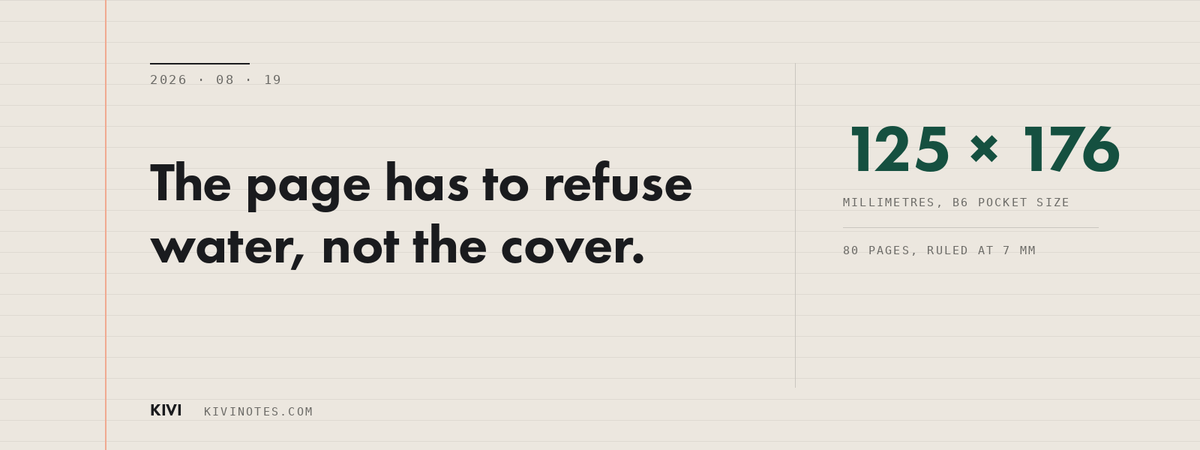
Best waterproof notebook for fishing: what to actually look for
A fishing notebook has a job a desk notebook never meets: it gets wet, and it gets wet with dirty hands. Rain, spray, a landing net dripping across the page, bait slime on your fingers. The best water resistant notebook for fishing is one where the sheet itself takes up no water, so the page does not pulp or go transparent and a ballpoint or pencil line stays where you put it. That rules out most of what is sold as a fishing log, because a lot of it is ordinary paper with the word waterproof on the cover.
That is the short answer. Here is the long one, because buying the wrong notebook is a lesson you only learn on the water, usually at the worst possible moment.
The trap in the word waterproof
Search for waterproof fishing log book and most of the top results are printed journals on Amazon. Nice covers, pre-printed columns for date, species, weight, lure. Read the reviews and you find the pages are ordinary paper. The seller put waterproof in the title because you typed it, not because the paper does anything in the rain.
There is a second group genuinely built for wet work. Two routes exist for that, and they are not the same thing. One is coated paper: ordinary wood paper with a water-repellent layer, so drops bead off the surface. Rite in the Rain is the best-known name there, with decades of field use behind it, so that is a serious product and not a trick. The other is a sheet containing no wood fibre at all, so there is nothing to soak up water. Stone paper, which is what we make, works that way. Neither is automatically better. They solve the same wet problem from opposite directions.
What actually matters on the water
Forget the cover. Four things decide whether a notebook survives a fishing season.
- The sheet takes up no water. That is the whole thing. A page that soaks up water cockles, goes transparent and lets ink bleed or lift. A non-absorbent sheet, coated or fibre free, lets it run off. Wipe and keep writing.
- You write on it with the pen you already carry. A ballpoint or pencil has to bite cleanly on a damp page. You do not want to hunt for a special pen under pressure every time you land a fish.
- It works one-handed. You often have a rod, a net or a fish in the other hand. A notebook that lies flat and takes a note without a second hand earns its place.
- It does not tear easily. Wet ordinary paper tears along the grain. Stone paper has no grain, so there is no direction to tear along.
Why a ballpoint beats an expensive pen here
The pen matters more than people expect. On a non-absorbent page ink sits on the surface instead of sinking in, so a gel or fountain line takes longer and a wet thumb drags it. An ordinary ballpoint pushes a thick, tacky ink that grabs the surface and dries fast, which is exactly what you want with wet hands and no time. Pencil is more forgiving still, because graphite does not care about moisture and takes beautifully to a slightly chalky surface. So the advice is boring: use the ballpoint from your coat pocket, or a pencil, and skip the expensive weatherproof pen unless you already own one.
What we do not know yet
This is normally where a brand writes a paragraph pretending to be honest about its own product's weak spot. We cannot write that paragraph, because we have not measured it.
What we know is material knowledge: there is no fibre in it, so there is nothing to take up water. What we do not know is where the limit sits. How long does a page survive submersion? What does a day in full sun on a metal hatch do? How hard can you rub a fresh ballpoint line before it smudges? Those are exactly the questions an angler asks, and no product page in this category carries a measured answer.
We will run those tests as soon as the proof copy arrives, with before and after photos, and put the outcome here. Including if it disappoints. Until then we say water resistant and nothing more, because inventing a limit because the copy asks for one is precisely what the rest of this category does.
What to log in a good fishing journal
A notebook is only useful if the pattern you write down helps you next time. Over a season those are the notes that slowly turn luck into reading the water, session by session. Worth noting every time:
- Date, water and swim, so you can go back to what produced.
- Weather, and if you fish the coast, the tide. Two lines that explain more of your catches than anything else.
- Water temperature and clarity, both more decisive for where fish sit than most anglers admit.
- Bait or lure, and the exact presentation, depth, retrieve speed or rig.
- What you caught, the size and the time, because the when is often the whole story.
- What did not work. The blanks teach you as much as the fish, and nobody writes them down.
You do not need a pre-printed grid for that. A plain lined page and a habit beat a handsome template you stop filling in by August.
Size, binding and weight
For fishing I would take a pocket-sized notebook over a large one. A B6 fits a jacket or the top tray of a tackle box and still gives you full width to write across, where an A6 starts to feel cramped once you note a few lines per fish. Binding is a real choice: a spiral lies bone flat for one-handed notes and folds right back, while a sewn notebook is slimmer and has no wire to catch your line or a net mesh. A non-absorbent sheet is a little denser than wood paper of the same thickness, so a fishing notebook is slightly heavier than it looks. You notice that across a whole notebook, never page to page. If you also camp by the water, the same story is in our guide to the best notebook for camping.
Is stone paper the greener choice for a fishing log?
Against paper from virgin wood pulp the production story for stone paper is real and checkable: no trees felled, no process water in forming the sheet, no bleach [1].
We don't quote a carbon percentage. We ran our own footprint and found that on carbon stone paper draws roughly level with ordinary paper: it wins in production and gives that back at the incinerator, because the plastic holding the sheet together is fossil. The full calculation, with sources and with the places it wobbles, is in we calculated our own notebook's carbon footprint. You will see 94 percent elsewhere; that comes from the MOYU life cycle assessment and covers an erasable notebook replacing fifteen single-use ones [2]. That gain sits in reuse and therefore does not apply to a permanent notebook like this one.
The downsides are just as real, and they count for something you will eventually drop in a marina bin. There is plastic in stone paper, so it is not biodegradable, not compostable and not plastic free. As a material it actually recycles better than paper: HDPE manages at least ten loops in tests while keeping its properties [3] and calcium carbonate does not degrade [4], against the four loops a paper fibre averages in Europe [5]. What is missing is collection, which is why you are welcome to send it back to us. More in our piece on whether stone paper is recyclable.
Frequently asked questions
Is a fishing notebook ever truly waterproof? No page is diving gear. A good one is water resistant: rain, spray and wet hands leave it alone because the sheet takes up no water. Submerging it finds the limit. Where that limit sits we have not measured, and we will not quote a number until we have.
Can I write on it with an ordinary pen? Yes, and you should. Ballpoint and pencil are ideal on a non-absorbent page. Gel and fountain ink work too, but dry more slowly, so a wet thumb smudges a fresh line.
Spiral or bound for fishing? Spiral lies flat and folds right back. Bound is slimmer and has no wire to catch your line. Both fine; it depends how you hold the notebook while a fish is on.
Does it work in the cold? Yes. It stays supple in frost and freezing spray, where damp wood paper would tear along the fold.
The short version
The best water resistant notebook for fishing is one where the sheet itself refuses water, so a ballpoint or pencil line survives rain, spray and wet hands without the page pulping. Buy on the non-absorbent sheet and not on the cover, and use the pen already in your pocket.
So for your next early start: which would you rather have, a catch log that survives the weather or the marketing? How our B6 stone paper notebook holds up on a wet deck is on the product page. No tree, no bleach, no process water, and here is what that does and does not mean in numbers.
References
- MOYU life cycle assessment: production without process water, Cradle to Cradle certified mill.
- The same assessment: 94 percent less CO2 for one erasable notebook against fifteen single-use ones over three years.
- Practical tests showing HDPE can be recycled at least ten times, published via Plastics Today.
- Pebble Printing Group, Stone Paper FAQ: calcium carbonate as a filler in recycled plastics.
- Cepi, Circular Economy: in Europe during 2024 every fibre completed on average four cycles of recycling and use.
KIVI B6, ruled, 80 pages, € 14.95. The waitlist gets 10% off.